Newsroom
Why Do Precision Positioning Systems Use Thin Section Angular Contact Bearings?
Precision positioning systems are widely used in semiconductor equipment, medical devices, optical instruments, industrial automation, and robotics. In these applications, even the smallest positioning error can affect product quality, operational stability, and overall system performance.
To achieve high accuracy while maintaining compact designs, many engineers choose Thin Section Angular Contact Bearings as a key component in their motion systems.
What Are Precision Positioning Systems?
Precision positioning systems are designed to control movement with extremely high accuracy and repeatability. Common examples include:
- Semiconductor wafer handling equipment
- Optical inspection systems
- Medical imaging devices
- Precision rotary tables
- Robotic joints
- Automated assembly equipment
These systems often require smooth motion, high rigidity, and minimal deflection under load.
Why Bearing Selection Matters
The performance of a positioning system depends not only on motors and control systems but also on the bearing arrangement.
An unsuitable bearing can lead to:
- Reduced positioning accuracy
- Increased vibration
- Excessive runout
- Premature wear
- Lower system rigidity
As positioning requirements become more demanding, bearing selection becomes increasingly important. 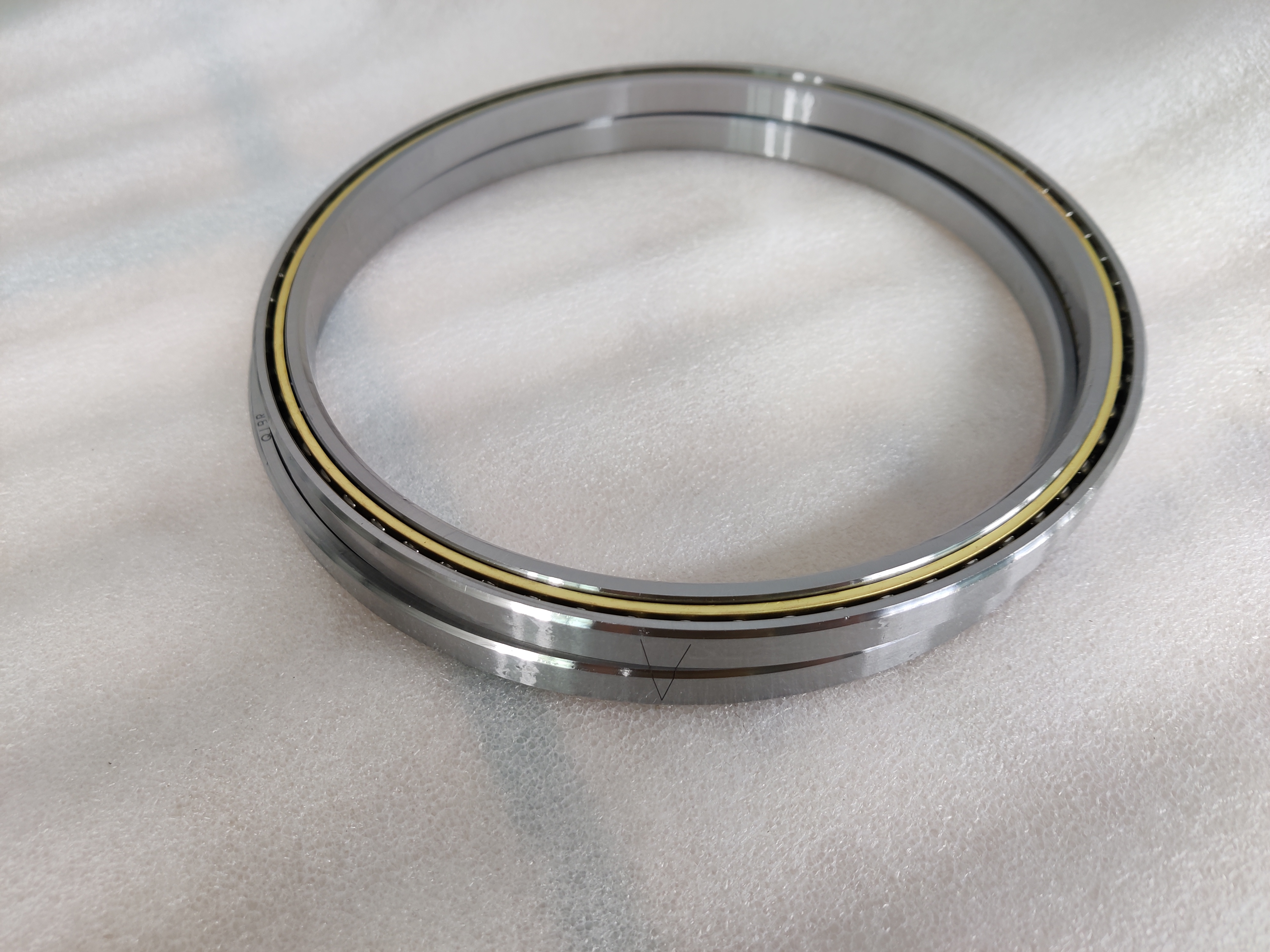
Advantages of Thin Section Angular Contact Bearings
High Axial Load Capacity
Unlike deep groove ball bearings, angular contact bearings are specifically designed to support combined radial and axial loads.
This makes them particularly suitable for positioning systems where thrust loads occur during acceleration, deceleration, or directional changes.
Improved Rigidity
Rigidity is critical for maintaining positioning accuracy.
The contact angle design allows angular contact bearings to resist deformation more effectively under load, helping maintain stable positioning performance.
Excellent Precision
Thin section angular contact bearings are often selected for applications requiring:
- High rotational accuracy
- Low runout
- Consistent repeatability
These characteristics are essential for precision automation and inspection equipment.
Space-Saving Design
Modern equipment is becoming increasingly compact.
Thin section bearings maintain a small cross-section regardless of bore size, allowing engineers to reduce overall system dimensions without sacrificing performance.
This advantage is especially valuable in robotic joints and compact positioning mechanisms. 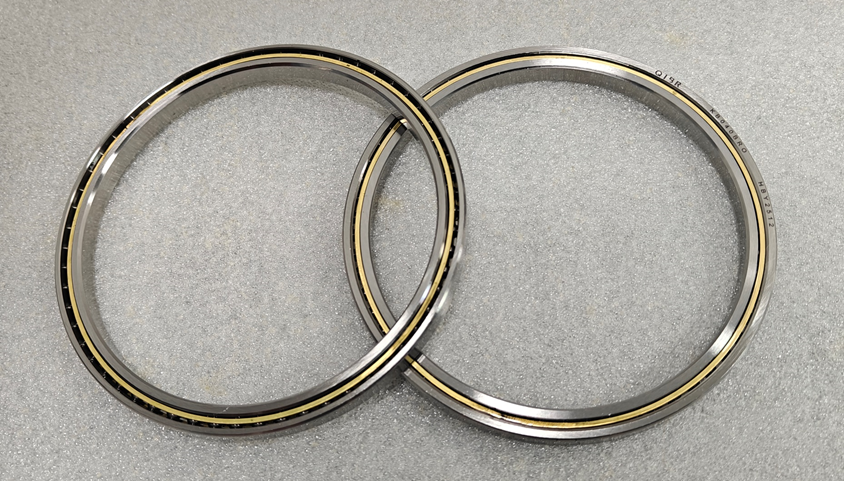
Typical Applications
Thin section angular contact bearings are commonly used in:
Semiconductor Equipment
Wafer processing and inspection systems require extremely precise motion control and positioning repeatability.
Medical Devices
Medical imaging and diagnostic equipment demand smooth and reliable rotational movement.
Optical Systems
Precision optics require minimal vibration and accurate positioning.
Robotics and Automation
Modern robots must combine compact design, lightweight construction, and precise motion control.
Thin section angular contact bearings help meet all of these requirements.
Thin Section Angular Contact vs Deep Groove Ball Bearings
Although both bearing types are available in thin section designs, their performance characteristics differ.
Deep groove ball bearings are often preferred for high-speed radial load applications.
Angular contact bearings are generally selected when:
- Axial loads are significant
- Higher rigidity is required
- Positioning accuracy is critical
- Preload arrangements are needed
For many precision positioning systems, angular contact bearings provide the performance advantages necessary to achieve consistent results.
Conclusion
As precision equipment continues to evolve, the demand for compact, accurate, and reliable motion systems is growing rapidly.
Thin section angular contact bearings offer an effective solution by combining high rigidity, axial load capacity, precision performance, and space-saving design.
For engineers developing next-generation positioning systems, selecting the right bearing can be just as important as selecting the right motor or control technology.