Newsroom
Why Are Double Row Cylindrical Roller Bearings Suitable for High-Load Applications?
When equipment requires high radial load capacity, good stiffness, and reliable performance, Double Row Cylindrical Roller Bearings can be an effective bearing solution.
Compared with single-row cylindrical roller bearings, their two rows of rollers provide a larger load-carrying capacity within a relatively compact radial space. This makes them suitable for many demanding industrial applications.
What Are Double Row Cylindrical Roller Bearings?
Double Row Cylindrical Roller Bearings contain two rows of cylindrical rollers arranged between the inner and outer rings.
The rollers have a larger contact area with the raceways than balls, allowing the bearing to support high radial loads while maintaining good radial stiffness.
Common designs include NN and NNU series bearings, which differ mainly in the arrangement of the raceways and flanges.
Why Can They Handle High Radial Loads?
The cylindrical rollers distribute the load over a relatively large contact area. With two rows of rollers working simultaneously, the bearing can carry higher radial loads than many single-row designs of similar dimensions.
This makes Double Row Cylindrical Roller Bearings suitable for equipment where radial loading is significant and bearing rigidity is important.
High Radial Stiffness
In addition to load capacity, stiffness is an important consideration in many industrial machines.
The roller arrangement provides strong resistance to radial deformation. This can help maintain shaft positioning and reduce unwanted shaft movement under heavy loads.
For this reason, Double Row Cylindrical Roller Bearings are often considered for applications such as machine tools, gearboxes, electric motors, generators, and heavy industrial equipment. 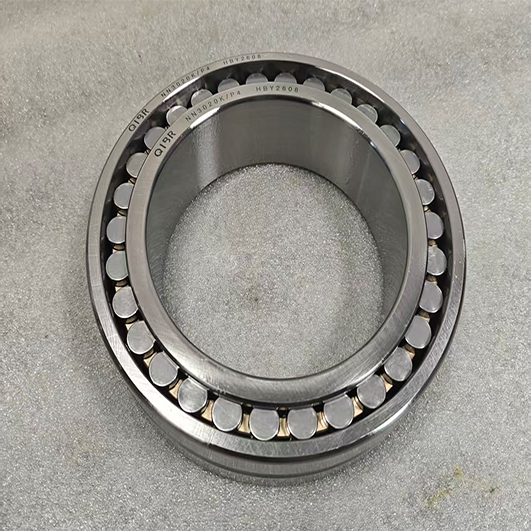
What About Axial Displacement?
Some cylindrical roller bearing designs can accommodate axial displacement between the shaft and housing.
This can be useful when thermal expansion causes the shaft to change length during operation. However, the axial locating capability depends on the specific bearing design.
For example, different configurations such as NN and NNU should not be treated as interchangeable without checking the application and mounting arrangement.
What Should You Consider When Selecting a Double Row Cylindrical Roller Bearing?
The bearing should be selected according to the actual operating conditions rather than bearing dimensions alone.
Important factors include:
- Radial load
- Rotational speed
- Shaft and housing dimensions
- Required radial stiffness
- Operating temperature
- Lubrication method
- Internal clearance
- Shaft and housing fits
- Axial displacement requirements
- Required bearing life
For high-speed applications, cage design, lubrication, and bearing precision can also have a significant effect on performance.
Where Are They Commonly Used?
Because of their high radial load capacity and stiffness, Double Row Cylindrical Roller Bearings can be used in a variety of industrial equipment, including:
- Machine tools
- Gearboxes
- Electric motors and generators
- Pumps and compressors
- Rolling mills
- Mining equipment
- Heavy-duty machinery
The final bearing design should always be selected according to the specific load, speed, mounting, and operating conditions.
Conclusion
Double Row Cylindrical Roller Bearings provide a combination of high radial load capacity, good radial stiffness, and a compact design.
Their two-row roller arrangement makes them particularly useful for demanding applications where conventional ball bearings may not provide sufficient radial load capacity or stiffness.
With the correct bearing type, internal clearance, fit, lubrication, and installation method, Double Row Cylindrical Roller Bearings can provide reliable performance in a wide range of industrial applications.