Newsroom
Thin Section Ball Bearings vs Crossed Roller Bearings
2026-07-22Thin-section ball bearings: Rolling elements are steel balls (point contact).
Crossed roller bearings: Cross-arranged cylindrical rollers (line contact).
Both feature ultra-thin cross-section and hollow structure for lightweight design, widely adopted in humanoid robots, CT scanners and semiconductor equipment, they differ greatly in rigidity, load capacity, speed rating and cost.
1. Structural Introduction
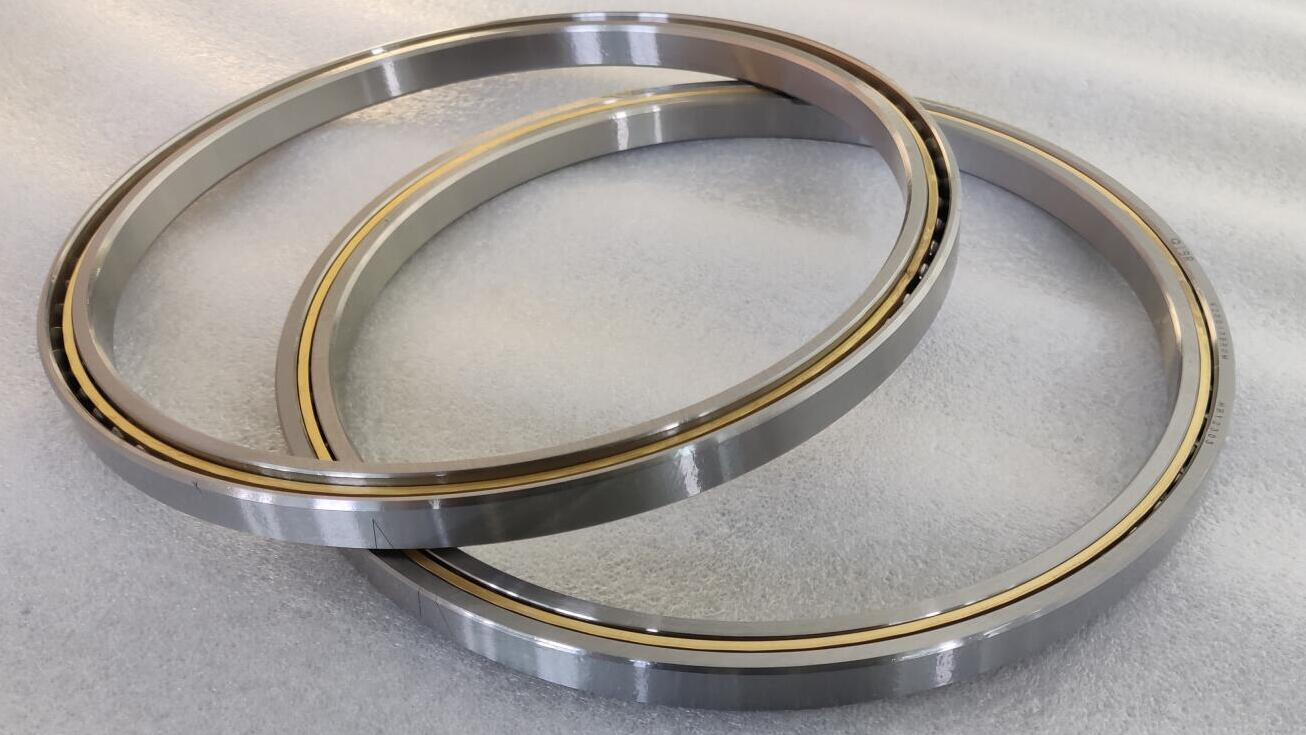
Rolling element: Steel ball
Main types:
- Type C (radial contact): Primarily for radial load
- Type A (angular contact): Radial load + unidirectional axial load, usually used in pairs
- Type X (four-point contact): Supports radial load, bidirectional axial load and overturning moment (most widely used)
Features:
Fixed cross-section dimensions within one series; wall thickness and width remain unchanged as bore diameter increases. Integral inner & outer rings, generally non-split structure.
Crossed Roller Bearings (CRBS / RA / XU Series) 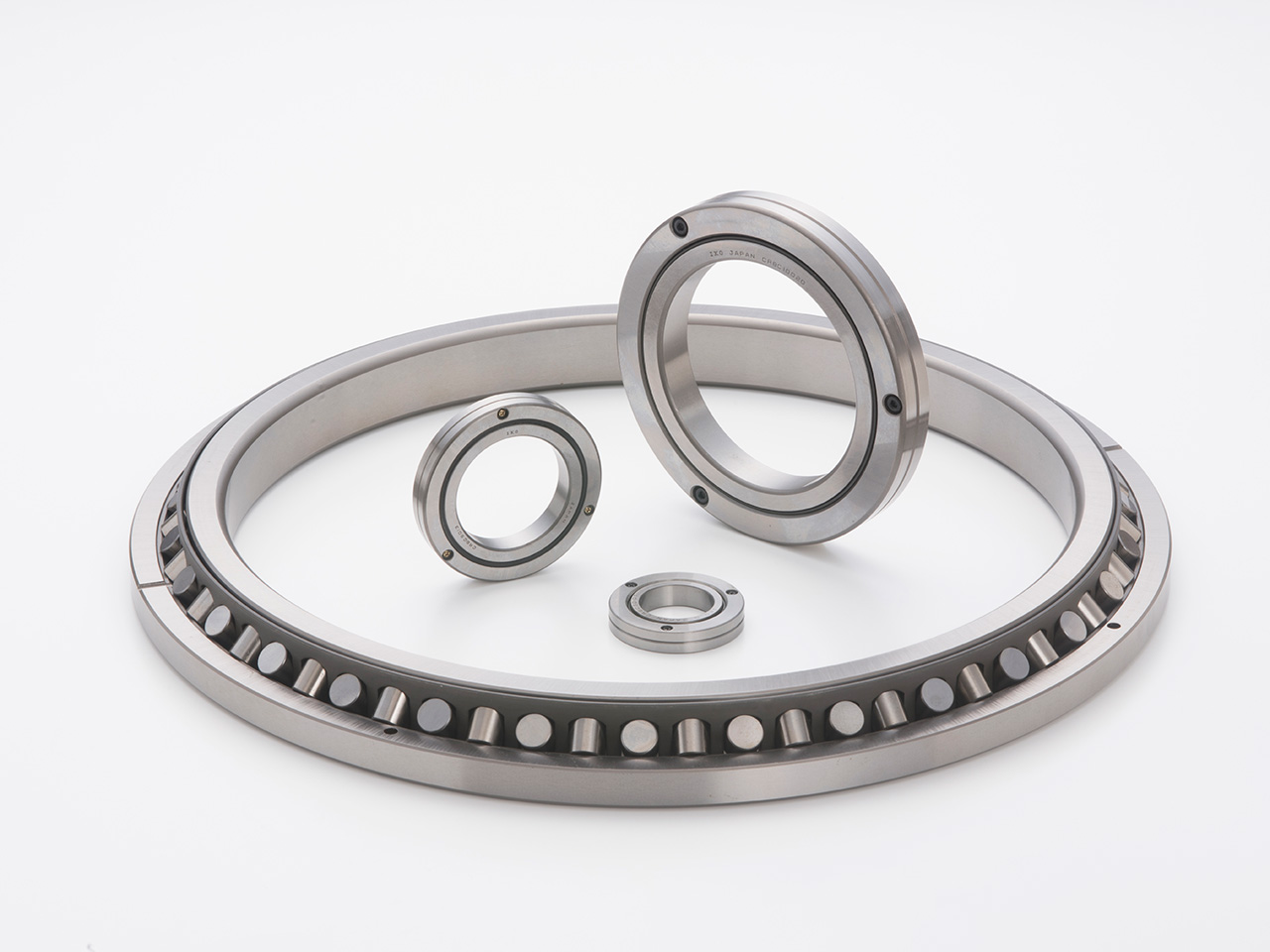
Rolling element: Cylindrical rollers arranged at 90° alternately in V-shaped raceways.
A single bearing can withstand radial load, bidirectional axial load and overturning moment simultaneously.
Features: Either inner ring or outer ring is split; clearance adjustment and preload can be achieved on site. Its cross-section is normally thicker than thin section ball bearings of the same bore size.
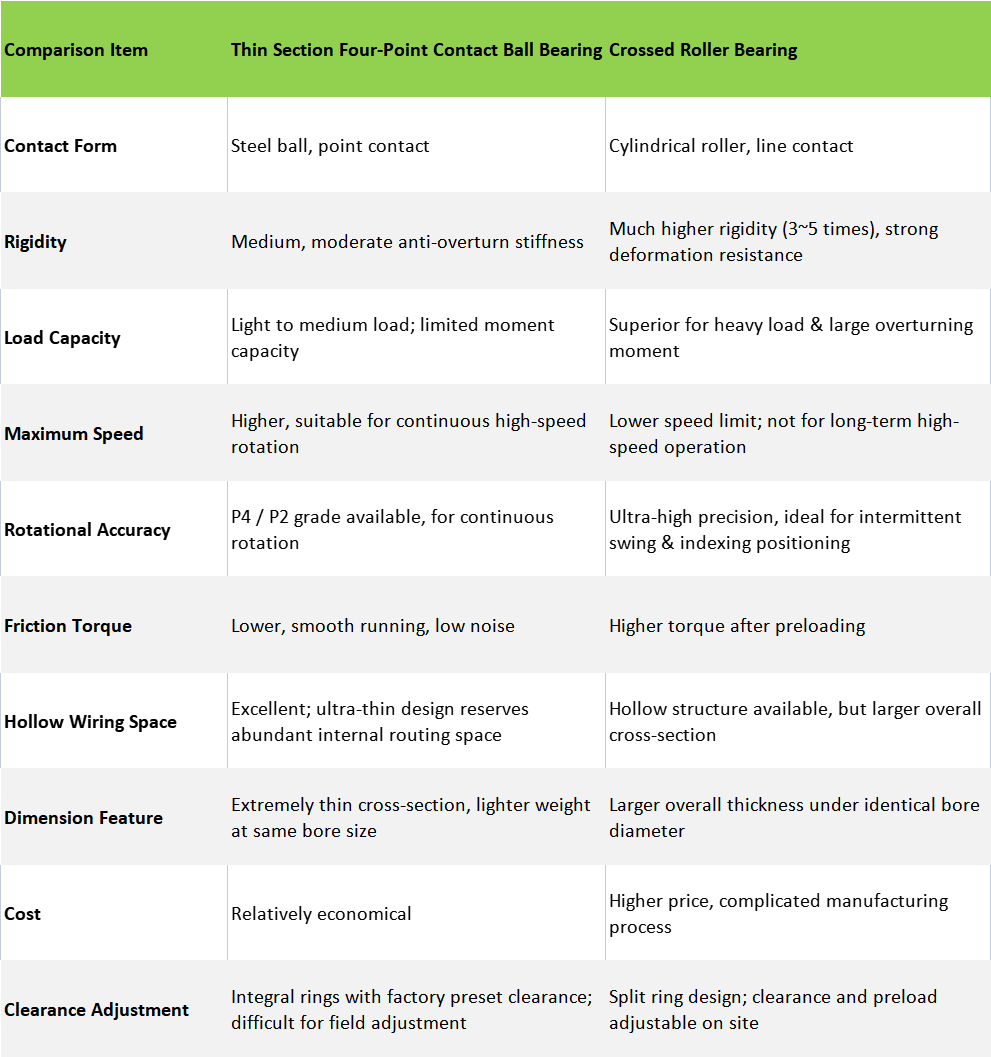
2. Performance Comparison Table
3. Typical Application Guidelines
✅ Choose Thin Section Four-Point Contact Ball Bearings
1. Continuous high-speed rotary motion required
2. Light/medium load with moderate overturning moment
3. Extremely limited installation space, lightweight & ultra-thin priority
4. Low torque and low noise requirements
Typical applications:
CT gantry, optical turntables, inspection equipment, waist/wrist joints & hollow routing joints of humanoid robots, PTZ cameras, semiconductor rotary platforms.
✅ Choose Crossed Roller Bearings
1. Heavy overturning moment, high rigidity and anti-deformation demand
2. Mainly for swing motion, intermittent indexing & positioning, not long-duration high-speed rotation
3. High repeat positioning accuracy required
Typical applications:
Wrist joints of 6-axis industrial robots, output end of harmonic reducers, precision rotary tables, CNC 4th axis, surgical robot joints, radar azimuth rotating mechanisms.
4. Common Industry Misconceptions
1. ❌ Misconception: All robot joints adopt crossed roller bearings
Many waist and torso joints of humanoid robots use four-point contact thin section ball bearings, benefiting from thinner profile, lighter weight and adaptability for continuous movement. Crossed roller bearings are more common on wrist joints and reducer output ends.
2. ❌ Misconception: Crossed roller bearings belong to thin section bearings
These are two independent categories in professional standards. The term "thin section bearing" generally refers to thin section ball bearings. Crossed roller bearings are classified separately.
3. ❌ Misconception: Four-point contact ball bearings can fully replace crossed roller bearings
Obvious gaps in rigidity and load capacity. Under heavy load and large moment conditions, point contact causes concentrated stress and accelerates fatigue failure.