Newsroom
The S03503CS0 Thin-Section Ball Bearing: Design, Performance, and Applications
Introduction
The S03503CS0 is a metric ultra-slim thin-section radial contact ball bearing that has become a de-facto standard in precision engineering. With a 35 mm bore, a 41 mm outside diameter, and a width of just 2.5 mm, it belongs to the 2.5 mm ultra-slim thin-section series — a family of precision bearings defined by a constant, extremely thin cross-section that remains the same regardless of bore size. This architecture lets machine designers reduce the envelope and mass of rotating assemblies dramatically while preserving the load capacity, rigidity, and running accuracy of a conventional ball bearing.
Decoding the part number
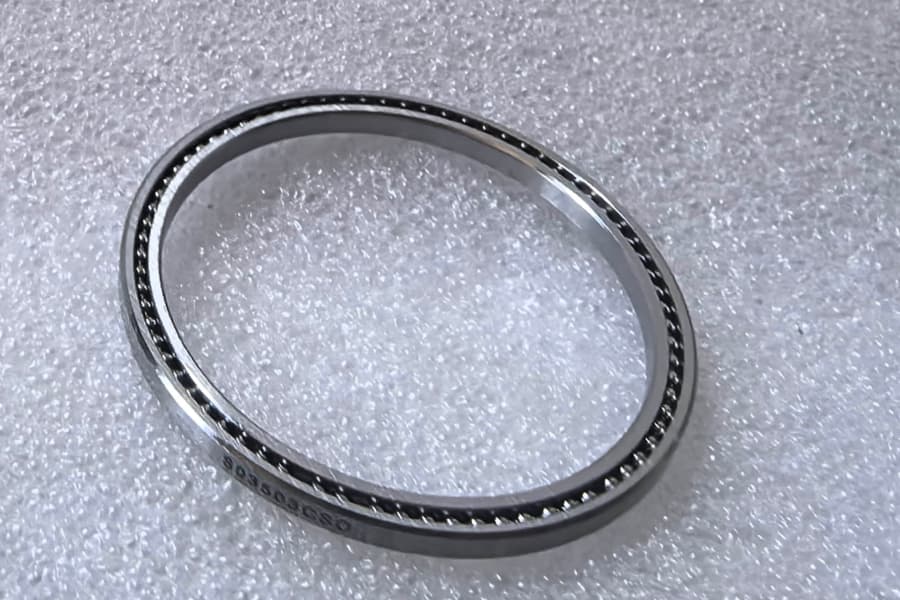
The designation itself reveals much about the product. The leading "S" identifies the ultra-slim thin-section series. The digits "03503" combine the bore code "035", corresponding to the 35 mm bore diameter, with the series code "03", which denotes the 2.5 mm cross-section group (the radial section measures 3 mm). The letter "C" specifies the bearing type: a Type C radial contact bearing, which is a Conrad-assembled deep-groove design with a zero-degree contact angle. Finally, the suffix "S0" indicates full stainless-steel construction — rings, balls, and cage alike. Read together, the code gives a buyer an immediate and unambiguous technical identity before a single dimension is verified.
Dimensional and design features
At 35 × 41 × 2.5 mm, the S03503CS0 is extraordinarily compact. The inner and outer ring shoulder (land) diameters measure 37.2 mm and 38.8 mm respectively, and the radial cross-section is 3 mm. The Type C construction employs deep, uninterrupted ball grooves ground without a filling slot; the balls are assembled by the Conrad method, giving a full complement of rolling elements in a single row. This arrangement is primarily intended for radial loading, but the deep grooves also allow it to carry modest thrust loads in either axial direction — a valuable trait in mechanisms where space does not permit a dedicated thrust bearing. Because thin-section bearings offer little resistance to tilting, the S03503CS0 is normally applied in pairs, or together with a second bearing, to stabilize the shaft against moment loads.
Materials and construction
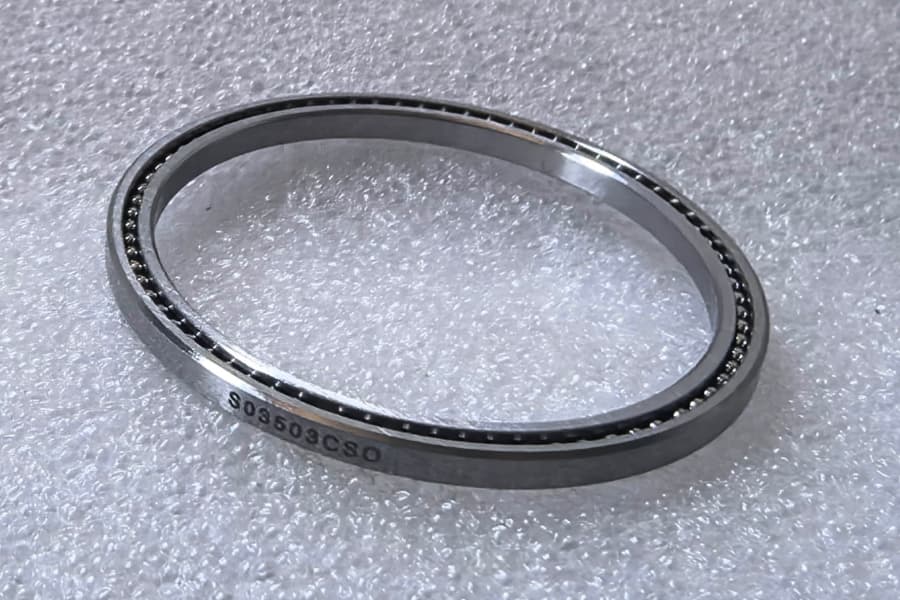
Corrosion resistance is a core strength. The inner and outer rings and the balls are manufactured from AISI 440C stainless steel, a martensitic grade that combines high hardness with excellent resistance to rust and chemical attack. The cage is also made of stainless steel, so the entire bearing suits clean-room, washdown, medical, and food-contact environments where standard bearing steel would quickly degrade. The bearing is of open construction and arrives pre-lubricated, ready for immediate installation. It is manufactured to ABEC-1 tolerance (ISO Class P0), which ensures consistent, low-vibration running in most commercial and industrial applications. Its typical service temperature range is −30 °C to +110 °C, with some manufacturer data quoting up to 121 °C.
Performance characteristics
Despite its slender proportions, the S03503CS0 delivers credible load capacity: both the dynamic and static radial load ratings are 418 N. Its small section yields a very low mass — approximately 5 g — which reduces inertia and the power required to accelerate or reverse a mechanism. Low friction, high stiffness, and good running accuracy are further benefits of the precision-ground stainless components. The standard radial internal clearance is 0.0000 to 0.0005 inch. Users should note that, like all thin-section bearings, the S03503CS0 is best suited to oscillating, indexing, and moderate-speed continuous rotation rather than very high-speed duty, and the shaft and housing fits must provide uniform support to avoid distortion of the flexible rings.
Typical applications
The combination of compactness, light weight, precision, and corrosion resistance has made the S03503CS0 a preferred choice across many industries. In robotics, it appears in the joints and actuators of compact robot arms and collaborative robots, where every gram and millimetre matters. Aerospace and defence equipment employs it in guidance systems, actuators, and compact control mechanisms. The medical sector uses it in surgical hand tools, dental handpieces, and diagnostic scanner assemblies that must withstand repeated cleaning. Precision instruments such as optical encoders, measuring devices, and scientific apparatus benefit from its smooth, accurate motion, while office-automation products — scanners, printers, and copiers — use it for compact rotary components. Additional applications include semiconductor-handling equipment, rotary indexing tables, radar and antenna-positioning mechanisms, and any mechanism where a reliable bearing must fit into an extremely limited space.
Installation and handling considerations
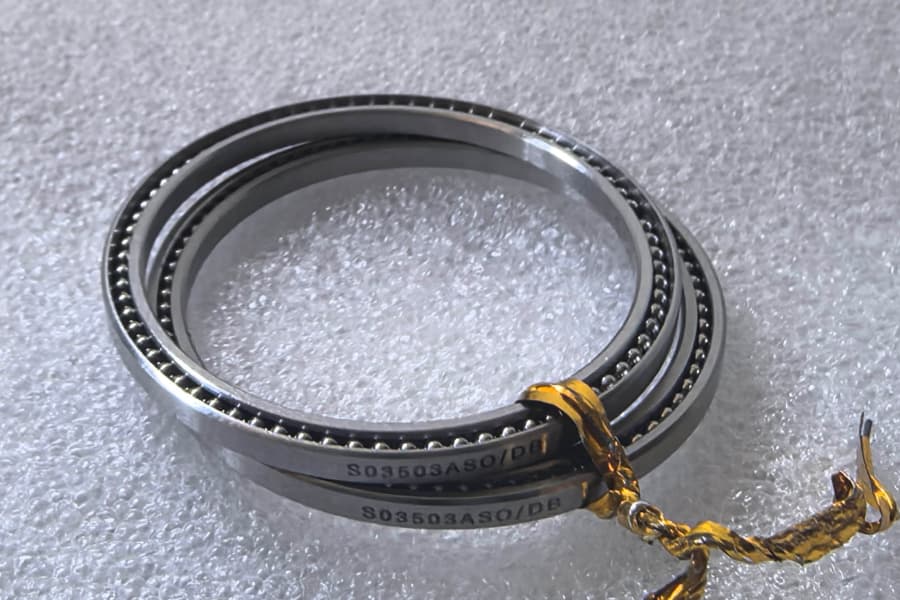
Because the rings are thin and comparatively flexible, handling discipline matters. The bearing should be supported uniformly during mounting, typically with a press fit onto the shaft and into the housing, and never subjected to localized force that could distort the raceway. The assembly must be kept clean and correctly aligned, and it is good practice to check radial clearance and run-out after installation, particularly in precision mechanisms. Where the application involves moment or tilting loads, a bearing pair should be used to provide adequate stability, and the preload should be selected in line with the manufacturer's recommendations.
Procurement and interchangeability
The S03503CS0 is widely stocked by authorized distributors and specialist thin-section bearing suppliers worldwide, which simplifies sourcing. When procuring, buyers should verify the tolerance class (ABEC-1 / ISO P0), the material (440C stainless steel), the clearance group, and whether the bearing is pre-lubricated, as these parameters can vary among alternative manufacturers offering cross-referenced products. Because the model number has become a de-facto industry standard within the thin-section family, it is relatively straightforward to compare quotations and confirm the exact specification before ordering.
Conclusion
The S03503CS0 exemplifies the value of the ultra-slim design philosophy: an extremely thin, constant cross-section that saves space and weight without sacrificing precision or load capacity. Its stainless construction, compact 35 × 41 × 2.5 mm envelope, and 418 N radial ratings make it a versatile, dependable choice for robotics, medical, aerospace, precision-instrumentation, and automation applications. Understood correctly — its designation, its performance limits, and its handling requirements — it rewards the design engineer with years of quiet, accurate, low-maintenance service in the tightest of spaces.