Newsroom
K34013XP0: A Comprehensive Analysis of High-Precision Thin-Section Four-Point Contact Ball Bearing
In modern precision machinery and advanced automation systems, thin-section bearings have become irreplaceable core components that balance lightweight design, compact spatial layout and multi-directional load-bearing capacity. Among numerous metric thin-wall bearing models, K34013XP0 stands out as a mature, widely applied four-point contact ball bearing belonging to the Reali-Slim MM series originally standardized by Kaydon, and it has achieved universal interchangeability among multiple bearing manufacturers including TFL, GQZ and FIJ. Distinguished by its ultra-narrow 13-millimeter width, standardized 340-millimeter inner bore and 366-millimeter outer diameter, this open-type single-row bearing solves critical structural bottlenecks in equipment where installation space is strictly limited while simultaneously sustaining complex combinations of radial, axial and moment loads. This article systematically elaborates on its structural design, material configuration, core mechanical performance, applicable operating conditions, industrial application scenarios, installation and maintenance specifications, as well as its unique competitive advantages in the precision transmission component market.
The naming rule of K34013XP0 fully reflects its core structural attributes, which helps engineers quickly identify its specifications without referring to lengthy data manuals. The prefix “K” marks it as a metric constant-section thin bearing; the three-digit number “340” refers to the 340-millimeter inner bore diameter, while “13” represents the fixed 13-millimeter section width that defines the entire 13 series thin-wall product line. The suffix “XP0” carries two key definitions: “X” denotes four-point contact internal geometry, and “P0” corresponds to ISO P0 (ABEC 1) standard precision grade, the basic precision level suitable for most general industrial precision rotation scenarios. Unlike ordinary single-row angular contact bearings that only bear unidirectional axial force, the X-type four-point contact raceway of K34013XP0 creates four independent contact points between steel balls and inner/outer ring raceways, enabling the bearing to withstand bidirectional axial loads, radial loads and overturning moment loads at the same time with a single bearing unit. This integrated load-bearing design eliminates the need to match two sets of angular contact bearings for compound load conditions, significantly simplifying the overall mechanical structure and reducing total equipment weight.
Material selection directly determines the service life and environmental adaptability of K34013XP0. Its inner ring, outer ring and rolling balls are all forged and heat-treated from AISI 52100 high-carbon chromium bearing steel, the most mainstream bearing steel material in the industry. After precise quenching and low-temperature tempering treatment, the raceway surface reaches high hardness and excellent wear resistance, effectively resisting contact fatigue damage under long-term cyclic load impact. The bearing cage adopts solid brass forming, which delivers outstanding self-lubricating performance and low friction coefficient compared with plastic or iron sheet cages. The brass separator stably isolates each steel ball to avoid direct collision and friction between rolling elements during high-speed rotation, lowering operating noise and vibration amplitude. The overall finished product complies with RoHS environmental protection standards, containing no harmful heavy metal substances, and meets the green manufacturing requirements of new energy, medical equipment and aerospace auxiliary devices. The net weight of a single K34013XP0 bearing is only 1.02 kilograms, an extremely lightweight feature for a bearing with a 340-millimeter large inner diameter, creating valuable space margin for miniaturized equipment design.
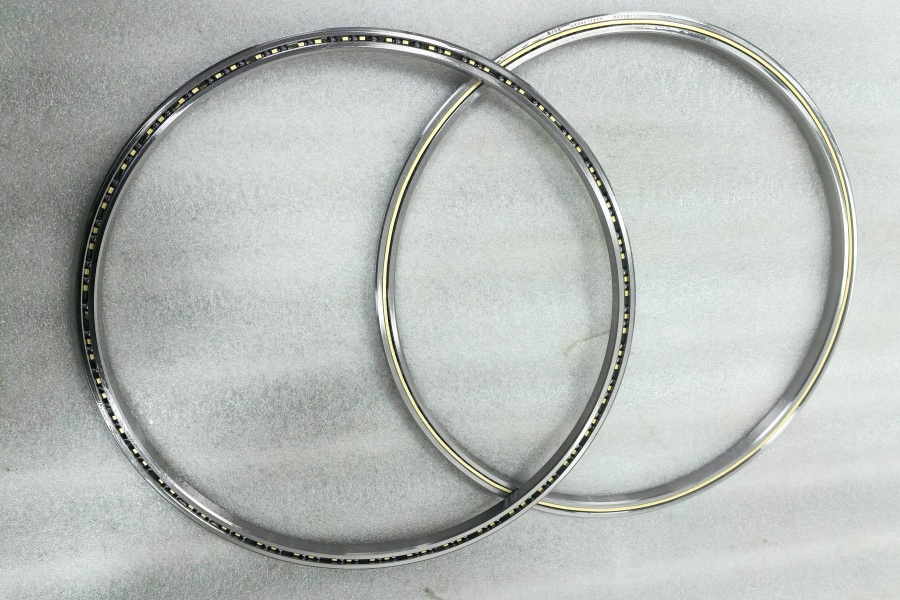
In terms of mechanical load performance, K34013XP0 presents balanced dynamic and static load ratings to adapt to long-duration stable rotation and static positioning working modes. Its dynamic radial load capacity reaches 24,595 Newtons, dynamic thrust load hits 40,531 Newtons, while static radial load is 52,613 Newtons and static thrust load climbs to 131,527 Newtons; the rated static moment load is 3,257 pounds-force, which can maintain stable positioning without permanent deformation under heavy overturning torque during equipment shutdown or low-speed locking states. The bearing adopts an open structure without built-in rubber or metal sealing rings, a design reserved for users to configure customized sealing components according to dustproof, waterproof and anti-pollution demands on site. Its applicable operating temperature range spans from -30 degrees Celsius to 110 degrees Celsius, covering normal indoor industrial workshops, low-temperature storage automation equipment and medium-temperature workshop production lines. For high-temperature environments exceeding 110 degrees Celsius, manufacturers support customized high-temperature grease filling and heat-resistant coating surface treatment to expand its temperature resistance upper limit.
The application fields of K34013XP0 center on precision rotary mechanisms with tight spatial constraints and compound load demands. The first major market segment is industrial robotic joint modules, especially large rotary bases of collaborative robots and light-duty handling robots. The thin-wall dimension reduces the thickness of robot rotary joints, optimizing motion flexibility while supporting the radial weight of mechanical arms and bidirectional axial offset loads generated during high-speed swinging. Second, it is widely matched with precision turntables, including optical detection turntables, industrial CT scanning rotating platforms and automated testing indexing tables. The four-point contact geometry guarantees high rotation rigidity, ensuring stable optical imaging and measurement accuracy without shaking during positioning and rotation. Third, medical equipment such as large CT and MRI auxiliary rotating racks adopt K34013XP0, where its lightweight characteristic lowers the overall power consumption of rotating drive motors, and RoHS compliance satisfies strict medical material safety standards. Additional scenarios include solar tracking rotary supports, aerospace auxiliary positioning turntables and automated logistics large-diameter rotary conveying platforms, all of which require large inner diameter, ultra-thin wall and multi-load bearing integrated bearings.
Correct installation and periodic lubrication maintenance are critical to extend the service life of K34013XP0. During assembly, interference fit is recommended between the inner ring and rotating shaft, and clearance fit between the outer ring and equipment housing to avoid raceway deformation caused by excessive assembly stress. Since it is an open-type bearing, users need to install external dust covers or contact sealing rings in dusty production environments to prevent metal debris, dust and liquid contaminants from entering the rolling area. Initial lubrication is completed at the factory with general-purpose lithium-based bearing grease; under continuous low-speed operation, supplementary grease maintenance is required every 3,000 working hours, while high-speed rotation scenes shorten the maintenance cycle to 1,000 to 1,500 hours. Over-lubrication must be avoided, as excess grease will generate high friction heat and accelerate grease aging, leading to early bearing failure. When disassembly and replacement are needed, non-impact disassembly tools should be used to prevent local stress damage to the thin inner and outer rings.
Compared with thick-wall standard bearings and smaller-size thin-section bearings, K34013XP0 possesses irreplaceable comprehensive advantages. Standard thick-wall bearings with identical inner diameter occupy far more axial installation space and increase equipment dead weight, failing to meet lightweight design targets; smaller series thin bearings cannot bear the heavy moment and axial loads required by large rotary platforms. Meanwhile, its universal interchangeability across multiple brands significantly reduces procurement costs and supply chain risks for machinery manufacturers, eliminating reliance on a single original brand supplier. Although the unit cost of K34013XP0 is higher than ordinary standard ball bearings, its structural simplification reduces the quantity of matching parts and overall assembly labor costs, delivering superior total cost performance in the full equipment lifecycle.
In conclusion, as a representative product of large-diameter metric thin-wall four-point contact bearings, K34013XP0 integrates ultra-compact structural size, multi-directional compound load capacity, stable precision rotation performance and wide environmental adaptability. With the continuous advancement of industrial automation, intelligent medical equipment and new energy optoelectronic industries, the market demand for miniaturized, high-rigidity rotary transmission components will keep growing, further expanding the application scope of K34013XP0. For mechanical design engineers, mastering its structural characteristics, load parameters and maintenance rules allows reasonable matching in rotary mechanism development, effectively improving equipment operation stability, reducing structural volume and lowering long-term operation and maintenance costs. This bearing remains an essential foundational component bridging lightweight structural design and high-load precision rotation in modern industrial manufacturing systems.