Newsroom
J05008XP0A Thin-Section Four-Point Contact Bearing: Precision in a Slim Profile
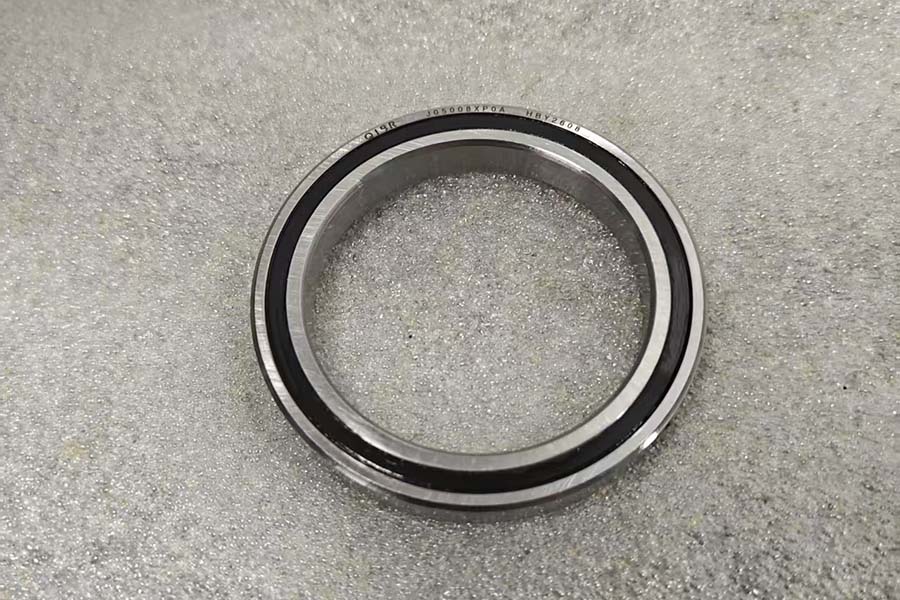
Hidden inside robots, medical scanners and rotary tables, small bearings often decide how precisely a machine moves. The J05008XP0A is exactly such a component: a thin-section, four-point contact ball bearing in the metric 8 mm series, supplied with seals for long, low-maintenance service. It has a 50 mm bore, a 66 mm outside diameter and an 8 mm width, so it carries the load capacity of a much larger bearing inside a strikingly compact envelope. This article looks at what the designation means, how the bearing is built, where it is used, and what engineers should check before specifying it.
Reading the Designation
Bearing designations look cryptic, but they are fairly systematic. In J05008XP0A, the letter J identifies the metric thin-section bearing family. The digits 050 state the bore diameter: 50 mm. The digits 08 name the cross-section series — here a square 8 × 8 mm section that the whole family shares. The X denotes a Type X, or four-point contact, design, and the trailing A is a configuration suffix that some manufacturers use to mark a particular variant, such as a specific seal or cage arrangement. Because coding schemes differ from maker to maker, suffix letters should always be confirmed against the supplier's catalogue rather than taken for granted.
The Idea Behind Thin-Section Bearings
Thin-section bearings rest on one simple principle: the cross-section stays constant no matter how large the bore becomes. Instead of growing with the shaft, the ring cross-section remains at the same 8 mm square for the entire series. This opens space at the centre of the machine — a shaft, cable, optics or tooling can pass straight through the bearing — while cutting weight, material and housing size. For designers of modern automation, the payoff is a machine that is lighter, shorter and cheaper to build without sacrificing a large, rigid central opening.
Four-Point Contact in Action
The defining feature of the Type X bearing is its raceway geometry. The rings are ground with a gothic-arch profile so that each ball touches the raceways at four points instead of the usual two. In practical terms, one bearing can handle radial loads, axial loads in both directions and the tilting or moment loads that often appear in real machines. Axial rigidity is high, and the bearing frequently replaces a pair of angular contact bearings mounted back to back. That single substitution simplifies the assembly, removes tolerance stack-up between components and saves both axial length and cost.
Construction and Quality
Material quality is what makes the design work. Rings and balls are machined from hardened high-carbon chromium bearing steel, and the raceways are precision ground to tight geometry. Cages are available in polymer, steel or brass, depending on speed, temperature and duty. The sealed version carries contact seals on both sides that keep grease in and dirt out, so the bearing runs cleanly for long periods without attention. Catalogue tolerances are typical of precision bearings: the bore is ground to about −0.012 to 0 mm, the outside diameter to about −0.013 to 0 mm, and the width allows only a small negative deviation. The complete bearing weighs roughly 0.08 kg.
Performance Profile
Because the cross-section is slim, the bearing generates little heat and runs with low frictional torque — important in positioning drives that index or oscillate rather than spin continuously. Catalogue figures place the basic dynamic load rating in the region of 4.5 kN and the static rating near 6.5 kN, although exact values vary with configuration. Sealed bearings trade a little speed capability for protection, and the moderate limiting speed is more than enough for turrets, tables and robotic joints. The combination of multi-directional capacity and low torque makes the bearing a natural fit for precision positioning rather than high-speed rotation.
Where the Bearing Is Used
Applications that demand compactness and precision are exactly where this bearing earns its place. In robotics, it supports joints and wrists where combined loads arrive from every direction. Semiconductor wafer handlers and metrology stages rely on its smooth, repeatable motion. Medical imaging systems and surgical robots value the large open bore, which leaves room for cables and optics. Rotary tables, indexing turrets and radar pedestals exploit its ability to carry radial, axial and moment loads in one unit, while packaging and printing machinery benefit from the low maintenance of the sealed design.
Mounting and Care
Precision is earned as much at installation as at the factory. The shaft and housing should be machined to accurate, concentric fits so the thin rings are not distorted by clamping. Axial clamping or a light preload helps the bearing run true and removes play. The bearing should be pressed evenly into position — never hammered — and handled with clean gloves, since even a speck of dirt can shorten its life. Sealed bearings arrive pre-lubricated and normally need no re-lubrication, but running noise, temperature and smoothness should be monitored periodically. For storage, keep the bearing dry, clean and protected against corrosion.
Choosing the Right Bearing
Before ordering, verify that the fit, speed, load and moment capacity match the application, and that the envelope — 50 mm bore, 66 mm outside diameter, 8 mm width — fits the design. Confirm the intended meaning of any suffix letters with the supplier, and compare catalogue ratings rather than assuming two similar-looking numbers are identical. For unusual duty cycles or precision grades, it is worth asking the manufacturer directly, since published values assume standard operating conditions that may not reflect a specific machine.
Conclusion
The J05008XP0A is a quiet example of how a well-designed component can simplify an entire machine. Its thin section saves space and weight, its four-point contact carries loads from every direction, and its sealed construction keeps maintenance to a minimum. For engineers building compact, precise rotating equipment, understanding what the designation says — and how the bearing works — turns a small steel ring into a confident design choice.