Newsroom
J02508XP0: A High-performance Four-point Contact Thin-section Bearing
In modern precision machinery design, the demand for lightweight, compact rotary components has continued to rise, pushing thin-section bearings into the spotlight of mechanical engineering. Among these specialized rolling bearings, the J02508XP0 stands out as a representative metric Reali-Slim four-point contact ball bearing, engineered to solve the conflict between limited installation envelope and complex combined load conditions. Unlike conventional standard ball bearings with enlarged cross-sections as bore sizes grow, thin-section bearings maintain a constant cross-sectional dimension, making them an irreplaceable option for space-constrained equipment design.
J02508XP0 follows the metric thin-section specification, with a bore diameter of 25 mm, outer diameter of 41 mm, and width of 8 mm. Its compact geometry is the core advantage of this bearing model. The “X” in the part number represents the four-point contact internal structure. Inside the bearing, steel balls form four contact points with the inner and outer raceways. This unique geometry allows a single bearing unit to carry radial load, bidirectional axial load and tilting moment load simultaneously. In many rotary designs, one J02508XP0 can replace a pair of matched angular contact ball bearings. This substitution reduces the total number of parts, shortens assembly length, simplifies fixture design and lowers overall equipment weight, which is extremely valuable for miniaturized mechanical systems.
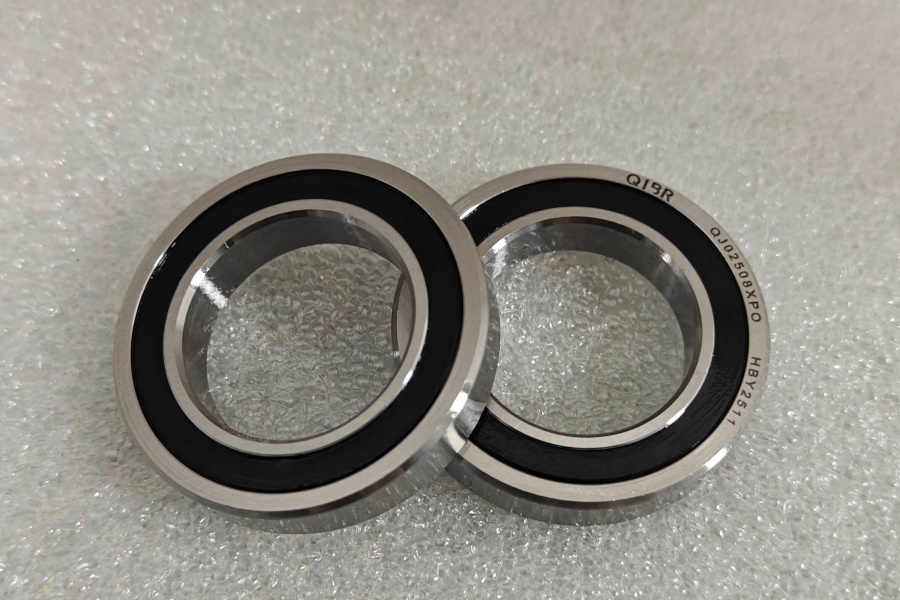
The J02508XP0 comes with integrated rubber seals as standard configuration. Seals serve two core functions: retaining pre-filled lubricating grease inside the bearing cavity and blocking external contaminants such as dust, metal debris, moisture and fine particles from entering the raceway contact zone. Contamination is one of the top causes of premature bearing failure. By isolating the rolling contact interface from harsh ambient environments, the sealed design effectively extends service life and reduces the frequency of maintenance and re-lubrication. For equipment installed in hard-to-reach positions or systems that require long continuous running without disassembly, this sealing feature greatly improves operational reliability.
Material selection and manufacturing precision determine the stable performance of J02508XP0. Most commercial versions adopt high-carbon chromium bearing steel, which delivers high hardness, excellent wear resistance and contact fatigue strength after heat treatment. The bearing is generally produced to ABEC-1 precision grade. Strict dimensional tolerance control ensures consistent running accuracy and low rotational runout. When the bearing operates, it maintains relatively low friction torque and smooth rotation, which helps reduce energy consumption and vibration in precision positioning systems. Low friction also cuts heat generation during continuous rotation, preventing thermal deformation that may affect positioning accuracy.
The load characteristic of four-point contact design requires engineers to fully understand application limits before selecting J02508XP0. While it can bear combined radial and axial loads, the bearing is optimized for moderate load scenarios rather than heavy impact loads. Overloading will accelerate raceway fatigue, induce early spalling on contact surfaces and lead to noise, vibration and sudden failure. Moment load capacity is another key parameter. In rotary joints, turntables and articulated structures, tilting moment often exists together with radial and thrust loads. J02508XP0’s structural design is tuned to resist such combined loads, but users must verify load spectra, duty cycle and rotation speed during the design phase to avoid exceeding allowable limits.
This bearing has found wide adoption across multiple high-end industries. Robotics is one of its primary application fields. Robotic arm joints, rotary wrists and collaborative robot articulations require compact bearings with both axial rigidity and moment resistance. J02508XP0 saves space inside robot joints while supporting precise positioning and repeated cyclic motion. Medical precision equipment also frequently uses this bearing. In CT scanning components, surgical robotic manipulators and optical diagnostic instruments, low vibration and high rotational accuracy are mandatory, and the thin-section structure fits neatly inside compact medical devices. Aerospace and satellite antenna positioning mechanisms are another major application area, where weight reduction directly reduces launch costs and improves system responsiveness. Semiconductor wafer handling equipment, optical turntables and precision machine tool rotary tables also rely on J02508XP0 for stable rotary motion within tight assembly space.
Proper installation is critical to fully release the performance potential of J02508XP0. The thin inner and outer rings of thin-section bearings have lower rigidity than standard bearings. Careless pressing, uneven force or misalignment during mounting may deform the raceway, resulting in degraded rotation accuracy and shortened service life. Engineers need to control interference or clearance fits carefully according to operating temperature and load. Excessive interference will create preload overload and increase friction heat. Too loose a fit causes ring creep, surface abrasion and positioning deviation. Axial preload adjustment is also important for four-point contact bearings. Appropriate preload improves rotational stiffness and positioning precision, while excessive preload raises torque and accelerates wear.
Lubrication management should not be overlooked. Factory pre-greased J02508XP0 bearings are suitable for most low-to-medium speed continuous applications. If the working environment features high temperature, high speed or heavy contamination, grease type and replenishment cycle must be reassessed. Grease degradation, oil separation and contamination accumulation will gradually increase friction torque and generate abnormal noise. Operators should monitor vibration, temperature and noise during routine inspection to identify early bearing deterioration before functional failure occurs. Storage is another detail. Bearings must be kept dry, away from corrosive vapors and vibration, and protected from rust before assembly.
Compared with other thin-section bearing types, J02508XP0 offers unique advantages and trade-offs. Radial thin-section bearings mainly handle radial loads and have limited axial load capacity. Angular contact thin-section bearings support one-direction axial loads and usually need paired mounting. The four-point contact J02508XP0 supports bidirectional thrust loads in a single unit, simplifying assembly. However, its rolling contact friction is slightly higher than pure radial thin-section bearings, so it is less suitable for ultra-high-speed applications with extremely strict torque requirements. Engineers should compare load type, rotation speed, space budget and maintenance requirement to decide whether J02508XP0 is the best choice among thin-section bearing families.
As precision equipment continues toward miniaturization and lightweight design, thin-section four-point contact bearings such as J02508XP0 will remain a key component in advanced mechanical systems. Its balanced combination of compact dimension, multi-directional load capacity, sealed protection and high running accuracy addresses many classic design bottlenecks. Still, reliable operation depends on correct load calculation, reasonable fit selection, careful installation and regular condition monitoring. When properly specified and maintained, J02508XP0 delivers stable, precise rotary performance and helps mechanical designers create more compact, lightweight and efficient rotary subsystems.