Newsroom
How can thin-section ball bearings be kept clean?
2026-05-29Thin-section ball bearings are significantly affected by their operating environment; inadequate maintenance directly impacts their service life. Let us first examine how the cleanliness of thin-section ball bearings affects their performance.
1. Impact on Vibration and Noise: Bearings with high cleanliness levels exhibit lower vibration values, particularly in the high-frequency spectrum. Experiments regarding dust in the lubricant have confirmed that higher dust levels result in increased noise.
2. Impact on Lubrication Performance: Reduced cleanliness not only hinders the formation of the lubricating oil film but also causes lubricant deterioration and accelerates aging, thereby degrading lubrication performance. 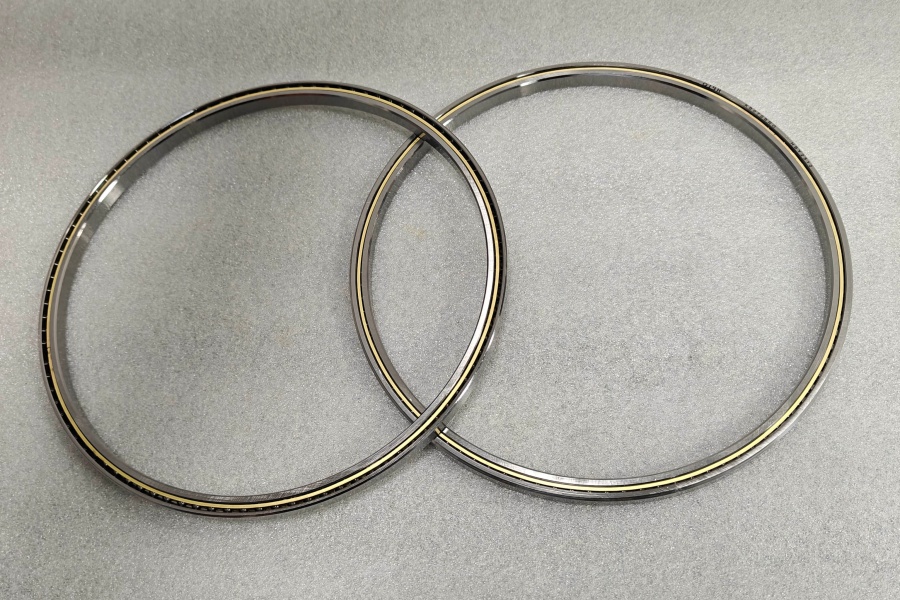
3. Impact on Service Life: Cleanliness has a profound effect on the service life of thin-section ball bearings; experiments have shown differences in lifespan ranging from several-fold to over ten-fold. Higher cleanliness correlates with longer service life. Studies indicate that lubricant cleanliness significantly influences bearing longevity. Excessive wear leads to increased noise and vibration and reduced operational precision, which in turn compromises the precision of the machinery in which the bearings are installed. Therefore, for bearings used in precision or quiet machinery, daily maintenance focuses primarily on preventing the ingress of contaminants and dust. Improving lubricant cleanliness extends bearing life; for instance, keeping contaminant particles below 10μm can significantly increase service life. Test results from bearing research centers indicate that cleanliness heavily influences vibration levels, especially high-frequency vibration. Regarding service life, the intrusion of contaminants and dust causes wear on the surfaces of rolling elements and raceways due to their relative motion. 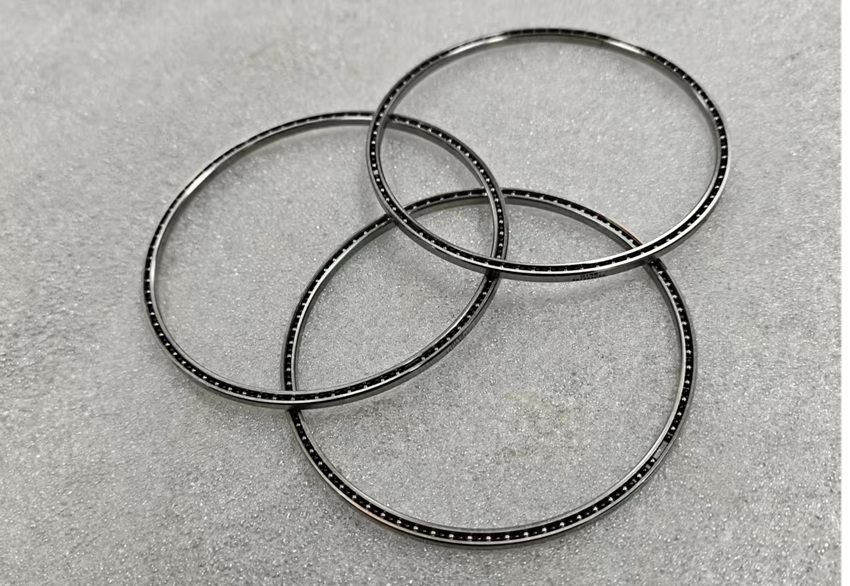
What causes damage to thin-section ball bearings? To verify the correct installation of thin-walled ball bearings, a test run can be performed after installation. Small bearings can be rotated by hand to check for smooth movement, whereas bearings in large machinery require an operational test. Key checks focus on whether the bearing operates smoothly; improper installation or the presence of foreign matter among the rolling elements can cause scarring, impede smooth operation, and ultimately damage the bearing.
The primary causes of damage to thin-walled ball bearings include the following:
1. Improper installation procedures. Excessive or incorrect force applied during installation or removal can deform or damage the bearing cage; therefore, it is crucial to control the force applied and use appropriate tools. 
2. Inadequate preparation and lubrication. Insufficient lubrication leads to component damage during operation. High-quality lubricating oil or grease should be selected and applied in the correct amounts.
3. Rust or corrosion on rolling elements. Storing bearings in damp environments or exposing them to water for extended periods causes rust on components, leading to flaking once operation begins. Regular inspection of the bearing's sealing integrity is essential to ensure effective protection. 
4. Minor component burns caused by electric current. Improper electrical handling during powered operation can cause damage. Measures should be taken to minimize grounding through the bearing or to prevent electric current from passing through it.
5. Unclean surrounding environment. Debris or dust falling into the bearing increases wear and causes abrasions. Particulate matter within the raceways should be removed promptly.