Newsroom
Comprehensive Analysis of S03503CS0 Ultra-Slim Constant-Section Radial Contact Ball Bearing
Bearings act as the core motion support component of all rotating mechanical systems, responsible for reducing rotational friction, bearing radial and partial axial loads, and maintaining precise positioning of moving components. As industrial design trends shift toward miniaturization, lightweight integration and high-precision compact equipment, traditional standard ball bearings with thick cross-sections can no longer meet the spatial constraints of emerging precision machinery. Among thin-section bearing products, the S03503CS0 ultra-slim constant-section radial contact ball bearing stands out as a representative model tailored for low-load, intermittent rotation and narrow installation space scenarios. Developed following Kaydon’s classic constant-section bearing design standard and fully interchangeable with S03503CS0 original parts, this stainless steel thin bearing fills the market gap between micro miniature bearings and conventional thin-wall bearings, balancing ultra-small volume, corrosion resistance and stable precision performance. This paper systematically elaborates on the structural design, material configuration, core mechanical performance, applicable industrial scenarios, installation specifications and daily maintenance guidelines of S03503CS0, providing complete technical reference for mechanical designers and equipment maintenance engineers, with an in-depth discussion on its unique advantages and application limitations in precision equipment manufacturing.
Structural Design and Model Code Interpretation of S03503CS0
The model number S03503CS0 contains complete structural and attribute information, each segment corresponding to a specific design parameter of the bearing. The prefix “S03503” defines the core dimensional specifications of the bearing: 35 mm inner bore diameter, 41 mm outer diameter and 2.5 mm ring width, with a fixed radial cross-section thickness of merely 3 mm. The letter “C” represents Type C radial contact ball bearing structure, also known as Conrad single-row deep-groove ball bearing, featuring zero contact angle and two-point contact between steel balls and raceways, which enables the bearing to bear bidirectional radial loads and limited axial loads simultaneously. The suffix “S0” indicates full stainless steel manufacturing for all bearing components, including inner ring, outer ring, rolling steel balls and the integrated thin stainless steel cage, eliminating the risk of galvanic corrosion between different metal materials inside the bearing.
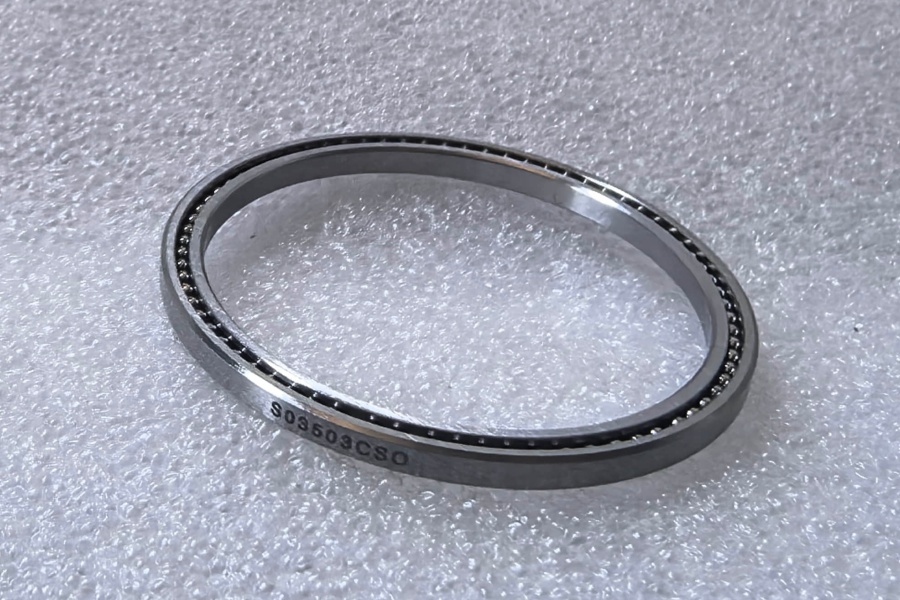
In terms of physical structure, S03503CS0 adopts an open non-sealed design without rubber dust covers or metal shields on both sides of the ring, which simplifies assembly and facilitates on-site lubrication replenishment but requires installation in relatively clean working environments. Its single-row ball layout uses evenly distributed small-diameter stainless steel rolling elements held by a thin stamping stainless steel cage, which avoids direct friction and collision between adjacent steel balls during rotation and maintains consistent ball spacing to ensure uniform load distribution on the raceway surface. The overall weight of the bearing is only 5 grams, a remarkable lightweight indicator compared with ordinary bearings of the same inner diameter; the ultra-thin 2.5 mm width drastically reduces the axial occupation space of the bearing assembly, a core design advantage for equipment with strict axial size limits. The bearing is manufactured to ABEC-1 precision tolerance class (equivalent to ISO P0 standard), with strict dimensional control: inner diameter tolerance ranges from 0 to -0.013 mm, outer diameter follows the same tolerance standard, and width tolerance is controlled between 0 and -0.127 mm, guaranteeing tight matching accuracy with mounting shafts and housing seats during assembly. Two shoulder reference diameters are reserved on the inner and outer rings, 37.2 mm inner shoulder diameter and 38.8 mm outer shoulder diameter, guiding engineers to design matched positioning steps for reliable axial fixing without additional snap ring structures.
Material Selection and Environmental Adaptability
All load-bearing and moving parts of S03503CS0 are made of high-hardness martensitic stainless steel, undergoing vacuum quenching and low-temperature tempering heat treatment to achieve uniform surface hardness and stable dimensional stability. Unlike carbon steel bearings prone to rust and surface pitting in humid or chemical environments, stainless steel materials endow S03503CS0 with excellent corrosion resistance against water vapor, weak acid mist, cleaning detergents and light saline solutions, making it compliant with RoHS environmental protection standards and applicable to medical food-grade clean workshops and semi-outdoor precision detection equipment without extra anti-rust coating treatment. The stainless steel rolling balls are polished to ultra-smooth mirror surfaces to minimize rolling friction coefficient, reducing operating torque and heat generation during intermittent rotation. The thin stainless steel cage has good flexibility and low mass, which will not produce excessive centrifugal force to interfere with ball movement under low-speed rotation conditions, unlike plastic cages that are prone to aging and deformation under temperature fluctuations.
The designed operating temperature window of S03503CS0 ranges from -30°C to 110°C, covering most conventional indoor precision equipment working conditions. At low temperatures below zero degrees Celsius, the stainless steel material maintains stable mechanical strength without brittle fracture; under continuous working temperature close to 110°C, the pre-filled standard lithium-based grease inside the bearing will not rapidly deteriorate or lose lubrication performance. However, the open structure limits its high-temperature upper limit: long-term operation above 110°C will accelerate grease volatilization, leading to dry friction and premature raceway wear. For ultra-low temperature cryogenic equipment or high-temperature baking machinery, customized low-temperature fluorine grease or high-temperature synthetic grease filling can be selected during bearing procurement to expand its environmental adaptability range.
Core Mechanical Load and Motion Performance
S03503CS0 belongs to light-load ultra-slim bearing, with consistent basic dynamic load rating and basic static load rating both reaching 0.418 kN (94 lbf). This load parameter defines its core application boundary: it is only suitable for light radial load working conditions, and cannot withstand heavy impact loads or continuous high axial thrust. As a Type C radial contact bearing with zero contact angle, its axial bearing capacity is far lower than angular contact Type A thin bearings and four-point contact Type X thin bearings; excessive single-direction axial force will cause uneven stress on rolling balls, forming local indentations on the raceway surface and triggering early noise and rotation jamming faults. Manufacturers clearly mark that S03503CS0 is not recommended for continuous high-speed rotation scenarios, and its optimal working mode is intermittent reciprocating rotation, swing positioning or low-speed indexing movement with short single operation duration and long stop intervals.
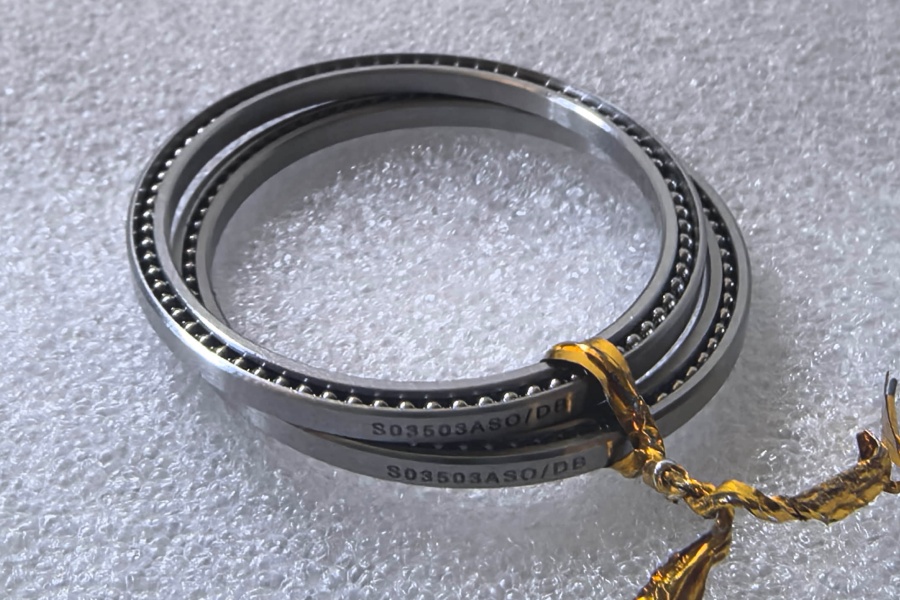
In terms of friction and positioning performance, the mirror-polished stainless steel contact surface and uniform ball arrangement bring ultra-low starting torque and stable rotational smoothness. When used in precision rotary tables, camera rotating supports and robotic joint miniature rotating shafts, the bearing can realize high-repeat positioning accuracy without obvious rotation hysteresis or stuck dead points. The medium C0 internal clearance reserved inside the bearing balances thermal expansion space during operation and assembly interference fit requirements: under normal room-temperature installation with light interference matching, the internal clearance will not disappear completely to cause excessive friction, nor will excessive residual clearance lead to rotary shaking and positioning deviation. Compared with thick-section bearings of the same inner diameter, S03503CS0 has lower overall rigidity due to thin ring wall thickness, so designers must avoid using it in equipment that needs to resist large radial deflection deformation; if high rigidity and ultra-slim size are required simultaneously, multiple S03503CS0 bearings can be installed in parallel to disperse load and improve overall structural rigidity.
Main Industrial Application Scenarios
The ultra-thin, lightweight, corrosion-resistant and precision positioning characteristics of S03503CS0 determine its concentrated application in precision light industrial equipment with strict space limitations and clean working environments, covering four core industrial fields.
The first field is medical precision equipment. Medical endoscopic rotating adjustment components, surgical instrument miniature rotary joints and medical imaging equipment rotary scanning platforms all require bearings that can resist disinfection liquid corrosion and occupy minimal internal equipment space. S03503CS0’s full stainless steel structure tolerates regular alcohol and disinfectant wiping cleaning, while its 5-gram ultra-light weight avoids increasing the load of handheld medical instruments, and intermittent swing rotation matches the short-time operation mode of medical equipment perfectly.
The second field is industrial intelligent robotics and automated inspection equipment. Miniature rotary joints of collaborative robot end effectors, vision inspection camera rotating supports and automatic optical detection (AOI) rotary indexing platforms rely on S03503CS0 to achieve compact mechanical arm layout. The low rotation torque of the bearing reduces the output power requirement of small servo motors, helping equipment manufacturers design smaller, lower-energy-consumption inspection modules; its stable ABEC-1 precision ensures that the camera and detection lens maintain consistent rotation positioning accuracy during repeated scanning.
The third field is optical and aerospace lightweight equipment. Professional industrial camera rotary focusing frames, small satellite solar panel miniature swing hinges and optical precision turntables all pursue extreme volume and weight control. S03503CS0’s constant thin cross-section design saves dozens of millimeters of axial installation space compared with standard bearings, and its non-magnetic stainless steel option (customized version) avoids magnetic interference with optical sensors and satellite electronic components, a critical advantage unavailable from ordinary carbon steel bearings.
The fourth field is food processing small automation machinery. Food packaging rotary positioning jigs and beverage detection miniature rotating mechanisms work in environments with water splashing and food residue pollution; the stainless steel bearing material resists rust from food liquid residues, and the open structure allows regular flushing and grease replenishment to maintain long-term stable operation of food-grade automation equipment.
Notably, S03503CS0 is excluded from heavy-load continuous rotation equipment such as high-speed motor spindles, large conveyor rollers and heavy machining tool turrets. In these scenarios, heavy loads or long-duration high-speed rotation will rapidly exceed the bearing’s load limit and accelerate fatigue wear, resulting in frequent premature failure and increased equipment maintenance costs.
Standard Installation Procedures and Precautions
Correct installation directly determines the actual service life of S03503CS0, and improper assembly is the primary cause of early bearing damage for over half of on-site failure cases. Before installation, the mounting shaft and housing hole must be thoroughly cleaned to remove metal burrs, dust and residual machining oil; tiny hard particles entering the open bearing raceway will form indentations on the steel ball surface during rotation, generating continuous abnormal noise. A thin layer of matching lubricating grease should be evenly coated on the shaft surface and inner ring inner hole to reduce assembly friction and prevent dry scratch damage to the stainless steel raceway during press-fitting.
For matching tolerance selection, light interference fit is recommended between the inner ring and shaft, and transition fit between the outer ring and housing hole, strictly following the bearing’s dimensional tolerance range to avoid over-interference which eliminates internal clearance and causes thermal jamming during operation. All assembly force must act on the bearing ring with the matching surface, never apply pressure through rolling balls or the thin cage; soft copper sleeve pressing tools are required for press-fitting to prevent deformation of the ultra-thin inner and outer ring walls, which would destroy roundness and rotational precision. After positioning, axial limit steps on the shaft and housing must closely fit the bearing shoulder reference diameters to eliminate axial play during swing rotation, preventing the bearing from shifting and bearing uneven partial loads.
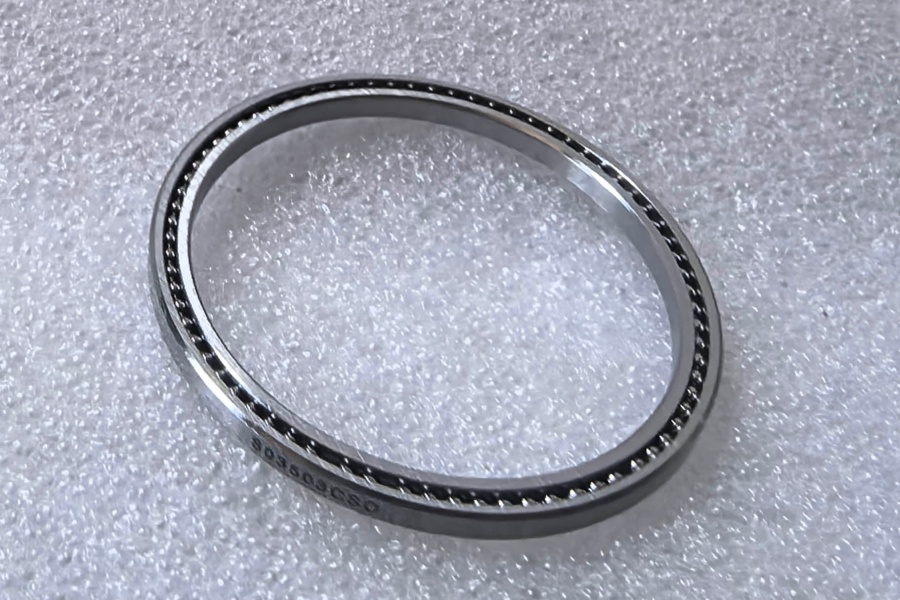
Post-installation inspection includes manual hand rotation test: the bearing should rotate smoothly without stuck points, abnormal friction resistance or obvious shaking. If rotation jamming exists, disassembly and re-cleaning are required to remove internal contaminants or adjust matching interference tolerance. For equipment working in dusty environments, auxiliary dust baffle structures need to be added around the bearing installation position to compensate for the lack of built-in sealing of the open S03503CS0 design.
Lubrication, Maintenance and Service Life Extension
Lubrication is the key factor controlling the service life of S03503CS0, and the bearing leaves the factory pre-filled with standard lithium-based general grease suitable for room-temperature intermittent operation. For normal working conditions with short daily operation time, supplementary lubrication is only required every six months; for equipment with daily continuous intermittent rotation exceeding two hours, grease replenishment cycles should be shortened to two to three months. When replenishing grease, disassembly of the bearing assembly is recommended to evenly inject new lubricant into the gap between the steel balls and raceway, rather than simply smearing grease on the bearing end face, to avoid insufficient internal lubrication film.
Daily regular maintenance includes three core inspection items: operating temperature, rotation noise and appearance corrosion. During equipment operation, the bearing surface temperature should not exceed 110°C; continuous temperature rise indicates insufficient lubrication or overloading, requiring immediate shutdown for inspection. Normal rotating sound of S03503CS0 is uniform low rolling friction sound; sharp metal squeaking or intermittent impact noise proves grease depletion or foreign particle contamination, which must be addressed before resuming equipment operation. In humid working environments, weekly visual inspection of the bearing outer ring surface is needed to check for rust spots; slight surface rust can be polished with anti-rust lubricant, while deep pitting corrosion requires direct bearing replacement.
The theoretical L10 fatigue life of S03503CS0 is calculated based on ISO 281 bearing life standard, related to actual applied radial load and total rotation cycles. When the actual working load is less than 50% of its 0.418 kN rated dynamic load and lubrication and installation standards are strictly followed, the bearing’s actual service life can reach three times its theoretical calculated fatigue life. Conversely, long-term overload, insufficient lubrication, contaminated installation environments or deformed bearing rings caused by improper assembly will reduce service life to less than one-tenth of the standard expected lifespan. Once the raceway surface shows fatigue peeling, steel ball deformation or cage cracking, repair cannot restore precision performance, and complete bearing replacement is the only viable solution.
Conclusion
As a mature ultra-slim constant-section thin bearing product, S03503CS0 perfectly integrates ultra-compact dimensional design, full stainless steel corrosion-resistant materials and stable light-load precision rotation performance, filling the market demand gap for miniaturized precision equipment with limited installation space. Its unique Type C radial contact structure, low mass and RoHS-compliant environmental design make it irreplaceable in medical devices, miniature robotic joints, optical inspection turntables and lightweight aerospace components, though its inherent limitations of light load capacity and unsuitability for continuous high-speed rotation restrict its application range to low-duty intermittent rotation scenarios.
For mechanical design engineers, fully mastering the dimensional parameters, load boundary, environmental adaptability and installation maintenance specifications of S03503CS0 is the prerequisite to exert its performance advantages and avoid early equipment failure caused by improper model selection or assembly errors. With the continuous advancement of miniaturization technology in precision manufacturing, the market demand for ultra-slim thin-section bearings represented by S03503CS0 will keep growing, and subsequent optimized upgraded versions with built-in sealing and hybrid ceramic rolling balls will further expand its applicable industrial scope, supporting the iterative upgrading of more lightweight, high-precision intelligent mechanical equipment.