Newsroom
Advantages of Crossed Roller Bearings in Robotic Applications
2026-07-30 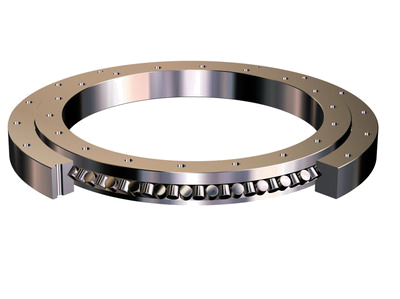 Crossed roller bearings feature rollers arranged perpendicularly at 90° to each other. Different from angular contact ball bearings, slewing bearings and thin-section ball bearings, they are the preferred supporting components for the joints of industrial robots, collaborative robots and surgical robots. Below is an analysis of their strengths combined with robotic operating conditions (lightweight design, compact joints, high precision and tilting load capacity), suitable for business promotion and technical communication with customers.
I. Core Technical Advantages
1. Integrated capacity for radial, axial and overturning moment loads
Ordinary bearings are generally designed for one dominant load type. Paired angular contact ball bearings are required to withstand overturning moments, while slewing bearings tend to be bulky.
A single crossed roller bearing can simultaneously bear radial loads, bidirectional axial loads and overturning moments.
👉 Robotic joints perform swinging and flipping motions with eccentric loads. One crossed roller bearing can replace two matched bearings and simplify the mechanical design of joints.
2. Ultra-thin radial dimension enabling miniaturization & weight reduction (key demand for robots)
For equivalent load capacity, its width is far smaller than slewing bearings and paired angular contact bearings, categorized as thin-section bearings with uniform cross-section.
Practical benefits:
- Smaller joint diameter and lighter robot arm structure;
- Lower motion inertia and faster dynamic response;
- Ideal for compact joints of collaborative robots, humanoid robots and surgical robots.
3. High rotational accuracy & rigidity for superior positioning performance
- Rollers realize line contact (in contrast to point contact of ball bearings):
- Higher rigidity and minimal deformation under load, ensuring excellent repeat positioning accuracy of robots;
- Precision classes up to P4 and P2 are available;
- Stable torque output with low vibration during operation.
- Comparison with thin-section ball bearings: Much higher rigidity under the same outer dimension, suitable for precision positioning scenarios such as visual alignment and surgical instruments.
4. Separable inner and outer rings for easy assembly
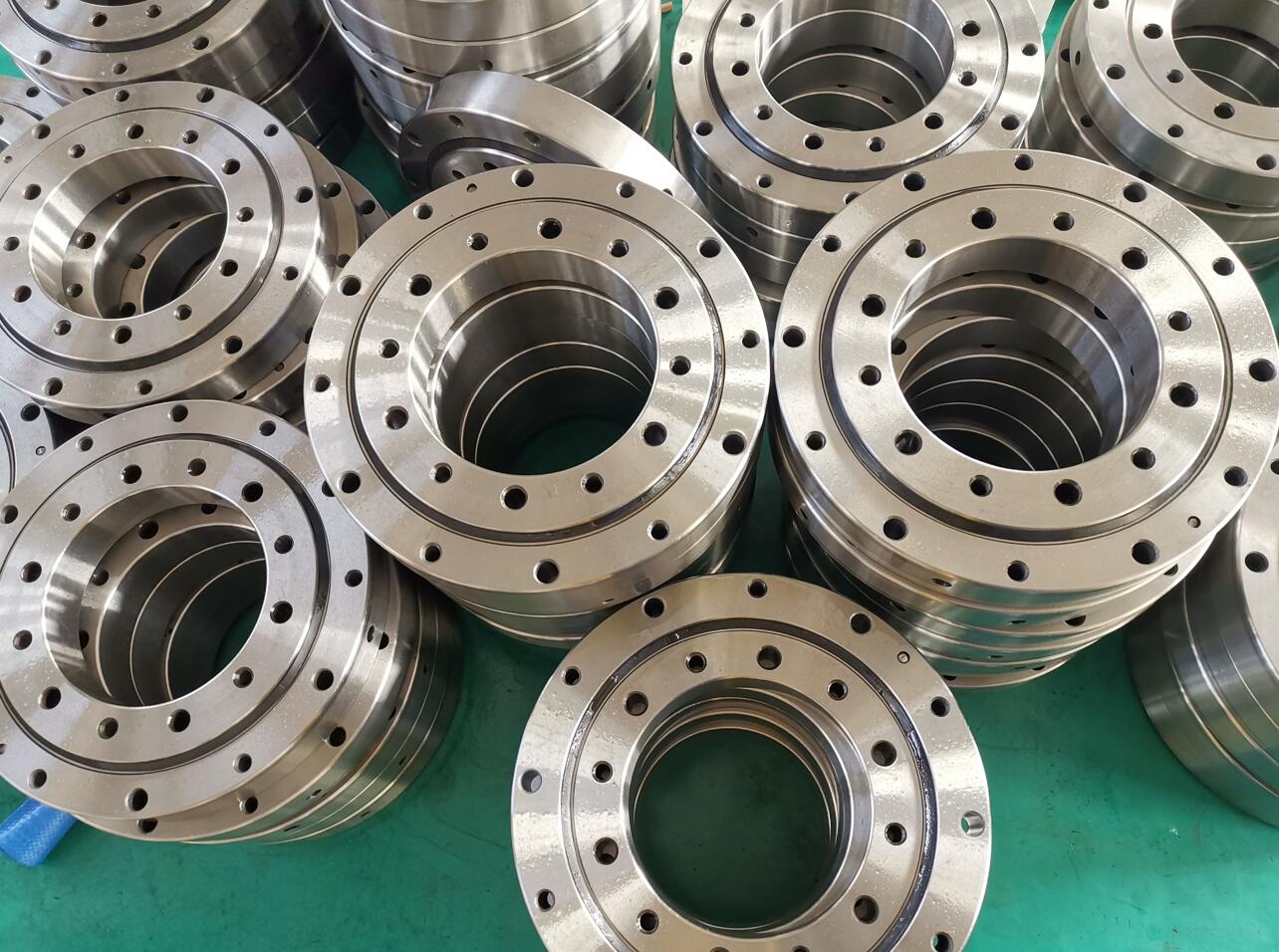
The split inner and outer rings allow separate installation. This facilitates built-in integration of encoders, servo motors and wiring harnesses, perfectly matching modular robotic joint design.
5. Low friction and smooth operation supporting servo control
With precision grinding and optimized preload design, the bearing maintains stable starting friction torque without obvious stiction.
It avoids low-speed crawling during closed-loop servo control, meeting requirements for precision operation.
6. Central hollow bore for internal cable routing (signature advantage)
Most crossed roller bearings are designed with a large central through-hole. Cables, air tubes and optical fibers can pass directly through the bearing center.
✅ Benefits: Prevent external cable entanglement, realize internal wiring inside robotic joints, avoid cable abrasion during continuous movement. Widely adopted in humanoid robot joints, surgical manipulators, SCARA robots and rotary vision platforms.
II. Application Value in Robot Segments
1. Surgical & Medical Robots
Non-magnetic stainless steel crossed roller bearings are commonly used. Slim structure, internal wiring, low vibration and high precision meet requirements of minimally invasive manipulator joints.
2. Humanoid Robot Joints
Light weight, low inertia and compact footprint are mandatory indicators; small-sized crossed roller bearings have become the mainstream solution.
3. 6-axis Collaborative Robot Joints
High rigidity and precision guarantee reliable drag teaching and repeat accuracy for precision assembly.
4. Delta Parallel Robots, Vision Rotary Platforms & Flip Fixtures
Capable of bearing eccentric overturning loads within limited installation space.
5. AGV Rotary Modules & Manipulator Rotary Bases
Integrated multi-load capacity simplifies base mechanical structure.